Objective: Learning to update records and label
accordingly when new donations/artifacts are donated to the museum.
Activities/Resources: Labeling and typing older information found on displays and exhibits into Microsoft Word because older files were on corrupt disks/defunct computer/word files, assisting the Executive Director, Pam, in determining newer information which cancels out outdated information from any older exhibits/displays.
Evidence: Include in portfolio photo of Adrian Block's map, which was donated to the museum by a Block Island resident, and discuss the importance of reentering information for cataloguing artifacts for this specific occurrence.
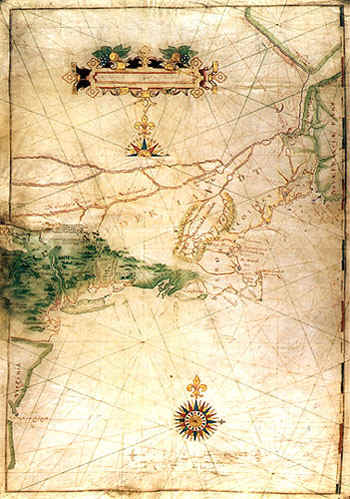
Above, I have included a copy of the map the B.I.H.S. received from a Block Island resident. This map was drawn by Adrian Block, who the island is named after. What is significant about this map is that is was done such a long time ago when technology was yet to be discovered. The detail and information Block was privy to still amazes people today, for such little advantages he had when this was drawn. When this map was donated to us, my task at the time was to update any information we had previously about this map, which was improved by having this map available to us. What is not visible with this scanned copy is at the bottom of the original map is information in english and (we believe to be) dutch, outlining the sources of this map, who drew it, where any additional information came from, and the time in which is was developed.
Out of all the displays/exhibits that I typed up, such as information on the Daughters of the Revolution (on Block Island), to information about Indians and Archeology processes, I was also asked to type up the information we had on Adrian Block and this particular section of map, which was considered to be the section of where Block Island is today. By updating this information, such as that he was not alone in drawing this map, and that this map was not available right after he finished it, it was lost to his records and was found at a much later date among another cartographers belongings, the B.I.H.S. is able to make history by adapting artifacts such as this map to accommodate new information.
After finishing with this project, I found myself even more involved in the history of Block Island, for typing all of this information given to me was lodged into my brain and continued to peak my interest. Not only did I learn about Block Island's history that was once unknown to me, I am now able to share this information and knowledge with friends and family and anyone who comes into the museum who might just want to know a little bit more about Adrian Block and his cartography. The labels/exhibits are now ready for the curator to create new exhibits as well as updating older displays for public viewing.
